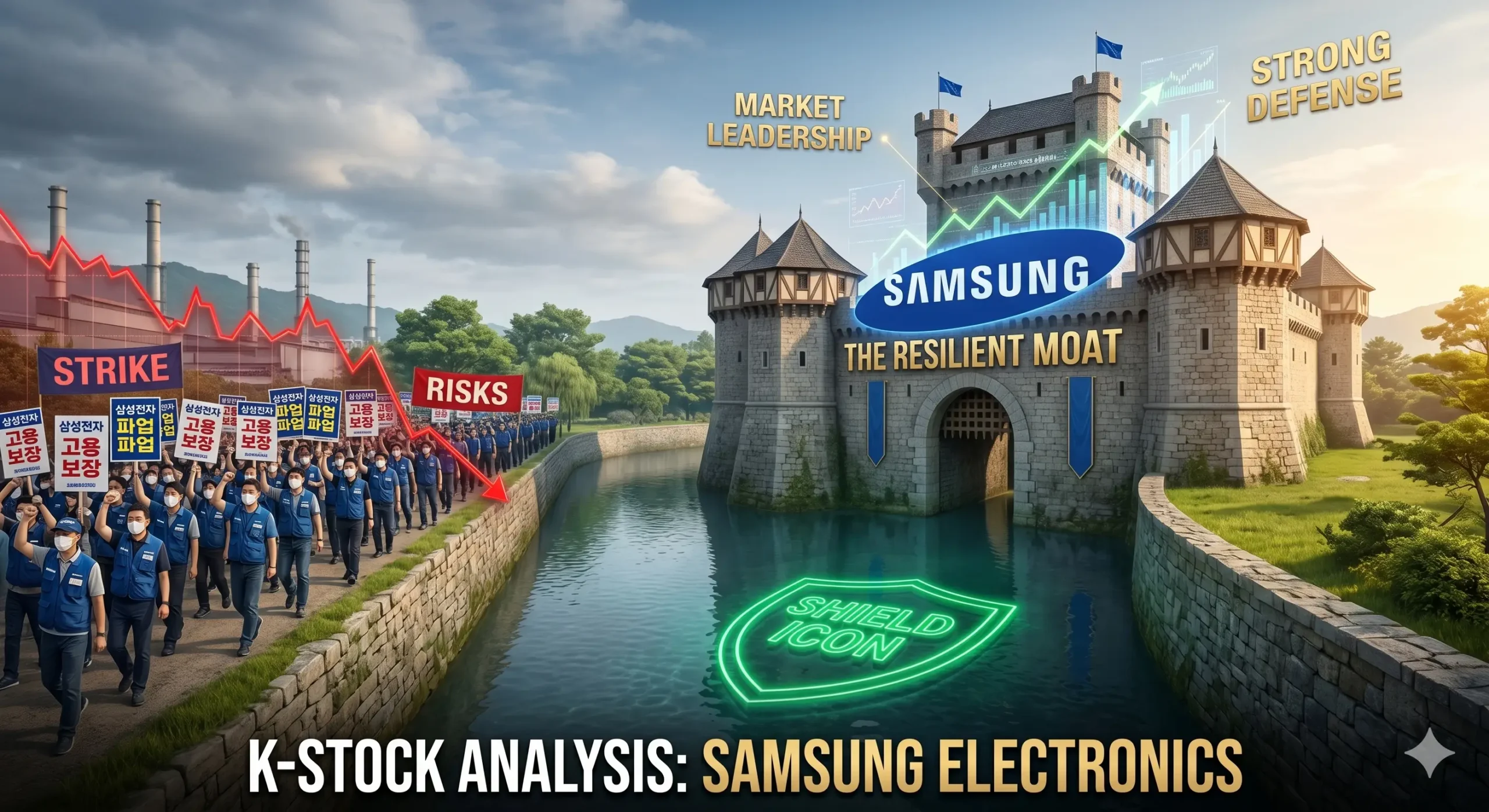
Key Takeaways for Foreign Investors
- The Core Feud: The general strike stems from structural disagreements regarding performance bonus allocation pools, specifically regarding whether non-profitable divisions (Foundry/System LSI) should receive uniform baselines.
- Automated Moat vs. Short-Term Friction: While short-term supply chain friction and sentiment drops are inevitable, the automated nature of modern mega-fabs buffers immediate capacity losses. The structural moat remains intact unless key R&D engineering talent permanently defects.
- Investment Horizon Lens: This macroeconomic event highlights why long-term allocators view localized systemic turbulence as an entry point rather than a thesis-breaker, aligning with broader macroeconomic governance interventions in South Korea.
The Hidden Dynamics of K-Stock: Samsung General Strike and the Resiliency of the Semiconductor Moat
On May 20, 2026, the National Labor Relations Commission (NLRC) in Sejong officially concluded its final round of intense post-mediation talks between the management of Samsung Electronics and its primary labor union without an agreement. Following this structural impasse over performance-based bonus allocations, the union announced its declaration to initiate an 18-day general strike starting May 21, 2026. This escalation represents a historic friction point for South Korea’s flagship enterprise, introducing temporary headline risk to foreign institutional portfolios exposed to the broader K-Stock ecosystem.
From a macro-analytical perspective, the critical question for global market allocators is not whether a short-term bottleneck will manifest—but rather how deeply this labor action threatens the intrinsic value and competitive moat of the enterprise. Historically, the global technology sector has seen episodic labor adjustments, yet the underlying competitive positioning of elite tech giants rarely erodes from internal compensation disputes alone. This article evaluates the structural realities of the strike, the technical buffer zones built into modern semiconductor fabrication, and why long-term capital allocators look past temporary local turbulence.
Deconstructing the Strife: Performance Principles vs. Labor Solidarity
The operational root cause of the current breakdown centers on a fundamental disagreement regarding corporate compensation principles. The labor union has heavily pushed for a structural shift in bonus distributions, demanding that approximately 15% of the firm’s total operating profit be hardcoded into the employee bonus pool. Furthermore, the union has demanded an equal redistribution of these funds across all semiconductor divisions—including underperforming or deficit-bearing units such as the System LSI and Foundry business segments.
Conversely, management has steadfastly adhered to its traditional governance architecture of “no bonus without performance.” Yield-driven industries require hyper-focused, department-specific incentives to maintain structural leadership in advanced nodes like High Bandwidth Memory (HBM) and next-generation server DRAM. Diluting this architecture to satisfy cross-divisional uniform baselines could significantly hamper the long-term agility of the tech giant. While the government has actively signaled the potential invocation of emergency mediation powers—a legal mechanism that can forcibly halt a walkout for 30 days to protect national economic security—the near-term reality involves an impending 18-day period of localized friction.
Evaluating Technical Vulnerabilities: Why the Moat Endures
Many retail investors and momentum traders fear that an immediate, multi-week halt will completely dry up global chip supplies, driving catastrophic capital flight. However, local market experts view this panic with skepticism due to the sheer technical composition of modern fabrication facilities (Fabs). Semiconductor manufacturing at Pyeongtaek and Hwaseong is among the most intensely automated operational architectures on the planet. Cleanrooms operate via automated material handling systems (AMHS) and overhead hoist transport (OHT) systems that require minimal direct physical intervention for baseline continuous operations.
Additionally, the Suwon District Court recently granted partial injunctions ensuring that critical maintenance crews and essential engineering staff remain on-site during industrial actions to prevent wafer degradation. While a prolonged full-scale stoppage stretching past the slated 18 days could theoretically affect high-touch packaging layers or test validation segments, the foundational economic moat—the patents, the multi-billion-dollar lithography infrastructures, and the extreme high-barrier capital expenditure requirements—remains fundamentally insulated. As long as the company maintains its underlying structural asset allocation and core technological intellectual property, the enterprise’s long-term terminal value remains decoupled from short-term collective bargaining volatility.
⚠️ Wait! Before adjusting your Korea exposure, you must understand the hidden ‘Local Premium Trap’ that domestic institutions are exploiting…
Decrypting Local Institutional Data & Blind App Sentiments…
Behind the Scenes: Inheritance Tax & Succession
To fully comprehend why high-net-worth families and internal strategists treat labor crises differently, one must look at the broader macro-corporate governance landscape in South Korea. Sophisticated wealth management offices operating in Seoul monitor these labor stalemates alongside long-term corporate governance developments. Historically, major conglomerates have faced a structural Chaebol discount due to complex cross-shareholdings and heavy systemic burdens under South Korea’s rigid fiscal framework.
For instance, complex family office dynamics often collide with strict local regulations during critical periods of inheritance tax planning. When foundational leaders navigate a massive succession premium transition, short-term downward pressure on stock values can occasionally facilitate more favorable structural asset valuations during intergenerational asset transfers. Therefore, domestic institutional players often exploit labor-induced emotional selloffs to build long-term structural positions, knowing that the underlying enterprise retains its massive secular advantages.
Retail Sentiment (Local ‘Blind’ App Leaks) & Value-Up Integration
An internal analysis of anonymous corporate sentiment via local employee networks (such as the verified ‘Blind’ application) reveals a highly fragmented labor force. While public union announcements emphasize uniform solidarity, senior hardware designers and memory engineers inside the profitable DS division have expressed underlying frustration. Many high-performing engineers are anxious that uniform bonus pools will dilute their individual performance-linked rewards, creating a hidden internal counterweight that could naturally shorten the strike’s practical viability.
Simultaneously, the South Korean government’s comprehensive Value-Up program is forcing major conglomerates to improve capital efficiency, enhance shareholder returns, and boost their long-term dividend yield profiles. This structural regulatory push means that management cannot afford to easily sacrifice financial discipline to satisfy short-term labor demands without facing intense pressure from global activist funds. Institutional offices are currently executing calculated portfolio rebalancing and strategic asset allocation maneuvers, utilizing this temporary dip as a highly liquid window to accumulation. The structural modernization of K-Stock governance ensures that cash flow preservation and tax optimization remain structural priorities, meaning the operational moat is destined to exit this crisis highly disciplined and fundamentally resilient.
*Disclaimer: This article is for informational purposes only and does not constitute financial advice.